

Aviator gives you two different experiences. Demo mode lets you practise the controls without registration, while real money play adds a stake, a cash-out request and an operator account.
The difference matters because the game can look familiar in both modes. The decision is not the same. A practice round can show how a multiplier rises and crashes, but it cannot show how you will handle money, delays or a losing run.
What Demo Mode Shows
Aviator demo mode needs no registration. It works in desktop, tablet and mobile browsers.
Spribe designed Aviator for low bandwidth and budget devices. Demo play can therefore show the basic interface on the type of device you use for real play.
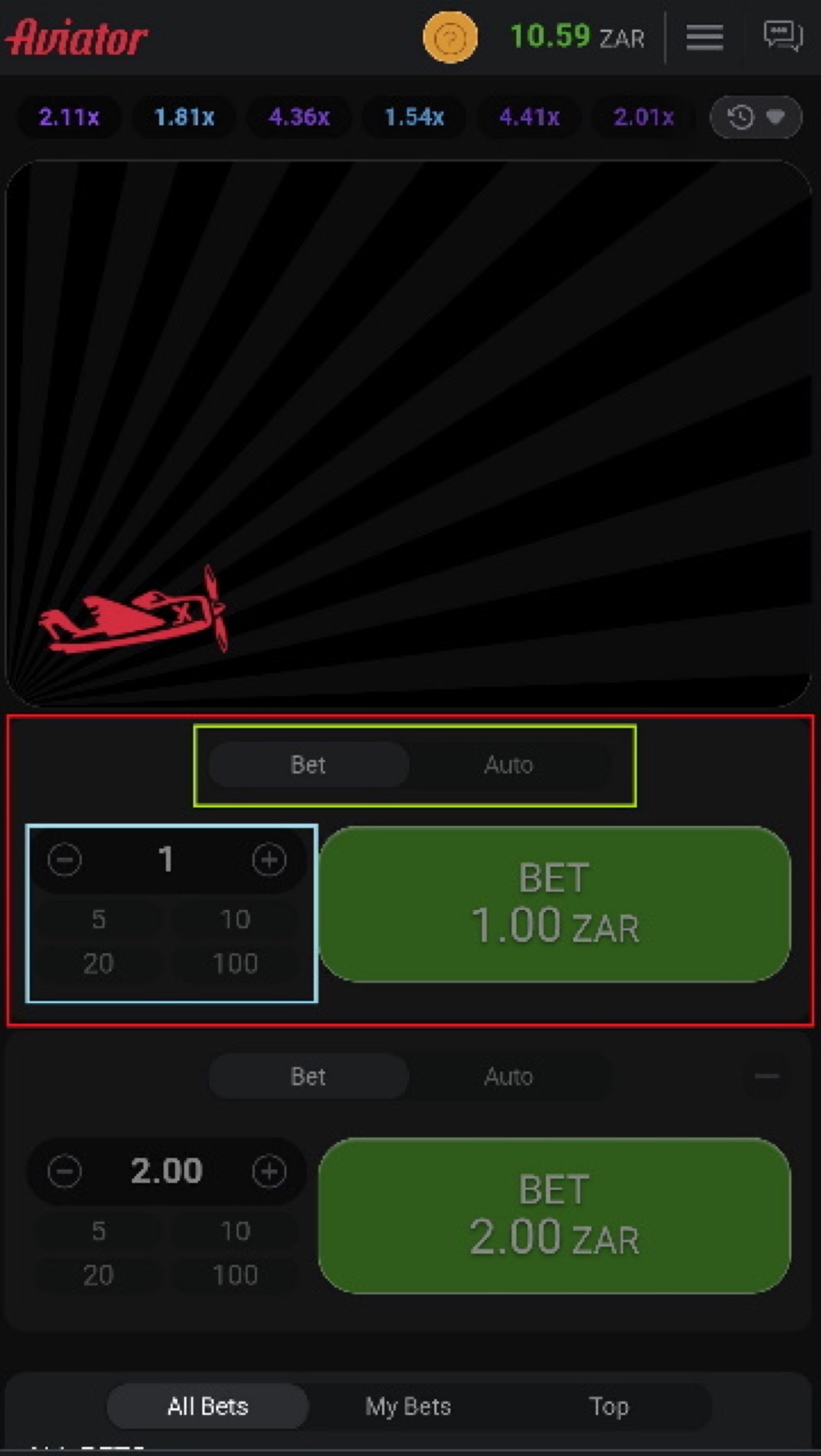
Aviator demo mode can show the mobile game view and its main controls.
Demo gives you a way to watch the increasing curve and practise a cash-out. It also lets you see the result when the round crashes before your chosen multiplier.
A round lasts about 8-30 seconds. There are usually 60-90 rounds per hour, with a few seconds between rounds.
These are the main things demo can show:
- How to enter a stake amount in a bet panel.
- How the multiplier increases after take-off.
- How to cash out before the crash.
- How the round history displays previous multipliers.
- How the Bet and Auto tabs organise the controls.
The game has two bet panels per round. Each panel can have a separate cash-out, so demo can also show how two decisions work at the same time.
One panel could cash out at 1.5x while the other stays active. That is a control exercise, not proof that this split will produce a profit.
Demo can also show Auto Cash-Out at a preset multiplier. Auto Bet and Auto Play can cover 10-100 rounds and include stop-on-win or stop-on-loss settings.
Use demo to answer practical questions before depositing:
- Can you find the cash-out control quickly?
- Can you read the round history without confusing it with a forecast?
- Can your device load the game without a frustrating delay?
- Can you stop Auto Play when you intend to stop it?
What Demo Cannot Show
Aviator has an RTP of 97% and a house edge of 3%. Demo mode cannot show the financial effect of that edge on your own balance.
A 1.00x instant crash occurs in about 3% of rounds, or roughly 1 in 33. Demo can show such a crash, but it cannot make the lost amount feel like a real stake.
The expected value is -3% of the stake at every cash-out target. A strategy can change variance, but it does not remove that edge.
| Target multiplier | Probability the round reaches it |
|---|---|
| 1.2x | 80.8% |
| 1.5x | 64.7% |
| 2x | 48.5% |
| 5x | 19.4% |
| 10x | 9.7% |
For example, a 1.5x target is reached in about 64.7% of rounds. That number does not mean a player wins 64.7% of sessions, because stake size, previous losses and cash-out timing affect the session result.
Demo also cannot reproduce the pressure of seeing a real balance fall. A player may accept an instant crash with virtual funds and then delay a cash-out after staking real money.
Demo cannot establish any of these points:
- Whether you will keep to a fixed stake.
- Whether you will chase a loss.
- Whether you will stop after a preset limit.
- Whether a cash-out request will reach the server before a crash.
- Whether the operator’s stake, payout or win rules suit your intended play.
Cash-out requests must reach the server before the crash. A slow device or connection can create a time-out, so a smooth demo session is not a guarantee of identical real-money timing.
Demo also does not show the operator-specific terms. Typical stakes range from about $0.10 to $100 per bet, but the actual range depends on the operator. Win caps per round are also set by each operator.
Free Bets Are Different
Rain Promo gives free bets through the in-game chat. The first players to tap “claim” receive them.
Operators can also grant Free Bets individually, in batches or by API. These promotions are not the same as Aviator demo mode.
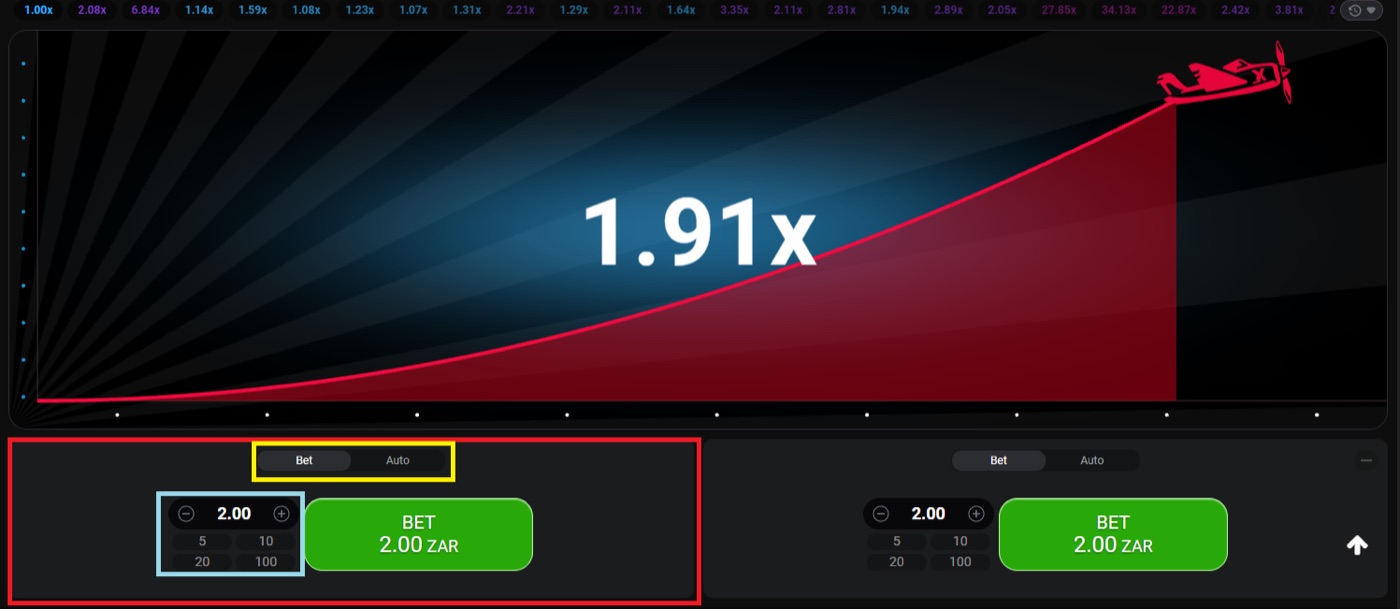
The desktop view shows a 1.91x round and two separate bet panels.
Demo uses no registration and no real stake. A free bet is a promotional value attached to an operator account or chat event. It belongs to real-money play, even when you did not pay for that particular stake.
The difference changes what you can learn:
- Demo shows the controls without financial exposure.
- A free bet shows real-money game flow without using the same type of deposited stake.
- Demo does not require meeting a promotion condition.
- A free bet may have operator terms, expiry rules or a required action.
- Neither format changes the 97% RTP or the 3% house edge.
Read the operator’s terms before treating a free bet as practice. The value may be limited, and the promotion may have a specific use or expiry condition. The exact conditions depend on the operator.
Do not use a free bet as evidence that a cash-out method is profitable. It can help you locate the controls, but it cannot turn a high-variance game into a predictable one.
Promotional chat can also change the pace of a session. A message may encourage another round just after a win or loss. Demo does not reproduce that pressure unless you deliberately create a similar routine.
Moving To Small Stakes
Aviator’s common stake range starts at about $0.10 and can reach $100 per bet, depending on the operator. A small real-money stake should be small for your own budget, not merely small compared with the displayed maximum.
The game has a high variance. A 10x target is reached in 9.7% of rounds, while a 1.5x target is reached in 64.7%.
Use a staged move from demo to real play:
- Play enough demo rounds to locate Bet, Auto, cash-out and history controls.
- Choose the lowest available real stake.
- Set a session amount before opening the first round.
- Use one simple cash-out target rather than changing it after every result.
- Stop when the preset loss or win limit is reached.
Suppose the lowest available stake is $0.10. Ten bets would put $1.00 into action if each bet loses, before considering any cash-outs. That arithmetic is clearer than judging risk from a multiplier on the screen.
A two-bet split is one approach described in Aviator guides. One bet may cash out at 1.5x-2x while the second remains open for a higher target such as 5x-10x. This changes how results are distributed; it does not beat the 3% edge.
Auto Cash-Out can reduce the need to click at a chosen multiplier. It cannot guarantee that the round reaches that multiplier, and it cannot correct a delayed connection.
Martingale is different from a risk limit. It doubles the stake after each loss and reaches 1,024x the base stake after 10 losses. Fibonacci and D’Alembert systems also do not remove the 3% edge.
Rounds are independent. A previous 1.00x crash does not make a high multiplier due, and a string of high results does not make an instant crash less likely.
Set a limit before play and do not increase the stake to recover a loss. If gambling stops being entertainment, stop playing.
When comparing a crash game, multiplier, cash-out or stake, you may see the phrase aviator game south africa in gambling searches; treat it as a search term, not evidence about odds or a bookmaker.
Real Money Interface Checks
Aviator displays two bet panels in each round. The interface also includes a live bets panel with All Bets, My Bets and Top views.
The round history appears at the top of the game. It records previous multipliers, but it does not predict the next crash.
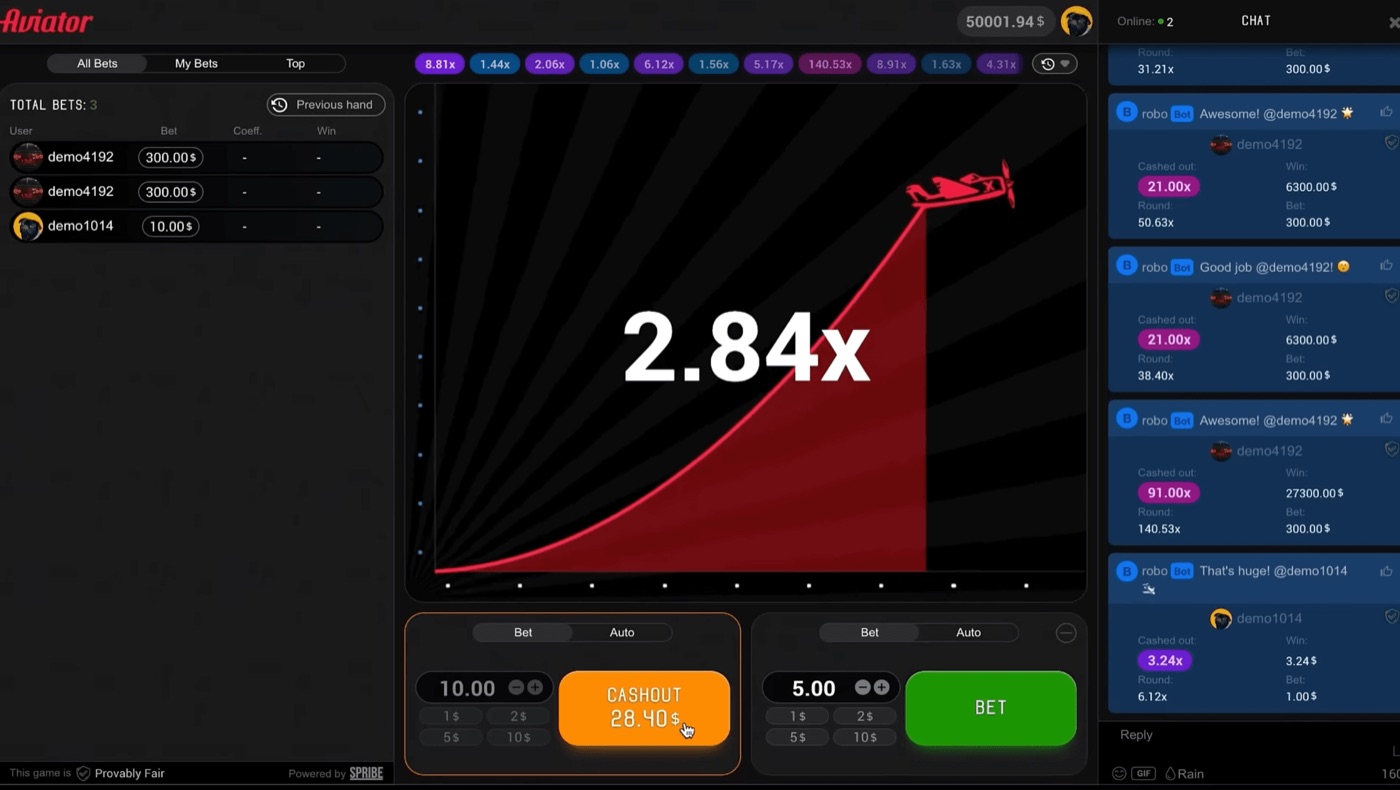
The full interface combines live bets, chat and a cash-out shown at 28.40.
Real play adds information that demo may not make financially meaningful. You can see your own bet beside live activity, and you must confirm that the cash-out request has been accepted.
Check these interface areas before using a real stake:
- The displayed stake before confirming a bet.
- The selected Auto Cash-Out multiplier.
- The active bet panel or panels.
- The cash-out result after clicking.
- The balance after the round ends.
The game also has in-game chat and a Provably Fair badge. Before each round, the server publishes a SHA-256 hash of the server seed. Client seeds from players are combined with it.
The crash point is fixed before take-off. Inputs are revealed after the round and can be checked with the verification tool inside the game. Neither the operator nor Spribe can change a result after the round starts.
That process explains why prediction apps do not provide a reliable bridge from demo to real play. “Patterns”, graph analysis, best-time claims and strategy chart PDFs do not change independent-round probabilities.
There is no standalone official Aviator app from Spribe. Aviator runs inside a licensed operator’s website or app, while apps using names such as “Aviator Predictor” are third-party products with virtual-coin or advertising disclaimers.
Use the operator’s website or app for real play. Check the displayed balance, stake and cash-out status before moving to another round.
Aviator FAQ
Aviator has 2 bet panels per round and a 97% RTP. Demo mode and real-money play use different levels of financial exposure.
The answers below separate what the game can show from what a player must manage personally.
Can I play Aviator for free?
Yes. Demo mode exists, needs no registration and works on desktop, tablet and mobile browsers. It lets you practise the interface without a real-money stake.
Is a free bet the same as demo?
No. A free bet is granted by an operator or through Rain Promo, while demo mode uses no registration and no real stake. Free bets may have operator-specific terms and expiry conditions.
Can an app predict Aviator?
No reliable prediction app can determine the next crash. The crash point is committed by a hash before the round, and independent rounds do not follow a usable pattern.
What does demo not show?
Demo cannot show how you react to losing real money, how an operator applies its stake and win rules, or whether a cash-out request reaches the server before a crash.
How should I start real play?
Use the lowest available stake, set a loss limit and choose controls you understand. The available stake and win cap depend on the operator.
Why did my cash-out time out?
A cash-out request must reach the server before the crash. Guides associate time-outs with latency or a slow device, so check the connection and device before continuing.